
Jochem Loos: Multi-sporting; gentle training
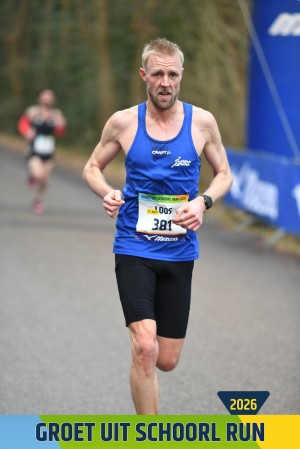
I met Jochem when I joined Leiden Atletiek for the first time in 2013: tall, lean and quietly spoken. We were training under the coaching of Roelofarendsveen and Leiden Atletiek legend, Jan Kortekaas. I was in my stage of beginner’s progress and for some reason I was performing more strongly than Jochem. I was always puzzled by this. Then, over a period of time, Jochem did start to improve his times and just after a breakthrough in his performance level, he was struck down by a nasty injury. This injury stopped him in his tracks. The Jan Kortekaas group, which in turn was led by Hans Wesseling and Norbert Groenewegen, lost a valued member for as long as three years. I had returned to Australia during this time and wasn’t sure of the details: all I noticed was that Jochem wasn’t running. Upon my return to Leiden Atletiek, friends spoke almost in hushed tones about how debilitating Jochem’s injury had been and his long-path back to consistent training.
From around 2021, Jochem was able to resume training steadily with the Kortekaas-Wesseling-Groenewegen group. During this time I trained either with Han and Bram or by myself. I noticed Jochem’s steady improvement and return to the level where he had been prior to his injury. We didn’t have much contact, but Jochem mentioned to me that his training was now a stronger mix of three disciplines: running, cycling and swimming. On top of this, Jochem has prioritised doing other things he loves: hiking, kayaking, skiing. The priority was on having a good time and not limiting oneself to a single discipline: do each one smartly and well and each practice will be complementary.
In late 2024, I took over the Kortekaas-Wesseling-Groenewegen Wednesday 19:00 group. This group values itself for being a mixture of both social runners and competitive athletes. And yes, there are also some more ‘senior’ runners who have been in the group for 30 years. Indeed, older than some of the other members in the group. My questions to Jochem were about what kind of training he was doing. He mentioned his three to four times a week of running; twice a week of swimming and cycling, more or less depending on the season. The variety of disciplines limited the risk of being injured and aided Jochem’s enjoyment of all three. By late 2024 was probably back to where he was prior to his injury. But probably the most satisfying element was that Jochem was staying injury free. He was steadily building up his consistency over a period of months, years. In my conversations with him, I wanted to intervene as little as possible. He had found his balance of sports.
Jochem runs with the fastest athletes in our group. And although he has the opportunity to fit in well with other ‘fast’ runners in other groups at Leiden Atletiek, he has chosen to stay in the 19:00 group. I see this as both a sign of his loyalty as a friend to others in the group and also his conviction in doing his own thing. The seemingly obvious decision or path isn’t necessarily the one that he takes . While he runs in the fastest group of my training group, I never see Jochem over-straining. He runs with an incredibly efficient style. He trains within his limits – allowing him to be fully recovered and rested for his next session. He maintains his efficient form for his races, while running at a much higher pace.
And in 2025, Jochem’s performances went up another notch: 15:51 for the 5km; 50:18 at the Zevenheuvelenloop and 1:12 at the Linschoten half-marathon. But one PR was still causing a degree of frustration in his mind: going sub-33 for the 10km. The Schoorl 10km (8th February) would be the ideal moment to tick that box. A week or two prior to the race I said to him ‘don’t wrorry about 32, Jochem, go straight to 31’. I wanted Jochem to shed his sensible and cautious approach - for this race. His Zevenheuvelenloop performance showed that he could perform well beyond his own expectations. I wanted to see him do it again. I wanted him to believe it was totally achievable. And so, he got a time of 31:38. A one-minute, 33 second PB. Indeed, PBs aren’t always a reliable measure of running performance – but to be able to combine it with pleasure and ease in running, I’d say, just about is. Congratulations Jochem.
Andy Fuller is the host of Everyday Runners podcast and coach of the 19:00 Wednesday Night Group.